Objects: Deploy
The estimated time to complete this lab is 60 minutes.
Overview
Data is growing faster than ever before, and much of the new data generated every second is unstructured. Video, backups, images, and e-mail archives are all examples of unstructured data that can cause issues at scale using traditional file and block storage solutions.
Unlike file or block storage, object storage is a data storage architecture designed for unstructured data at the petabyte scale. Object storage manages data as objects, where each object contains the data itself, a variable amount of metadata, and a globally unique identifier. There is no filesystem overhead as there is in block and file storage, so it can be easily scaled out at a global level.
Nutanix Objects is an S3-compatible object storage solution that leverages the underlying Nutanix storage fabric which allows it to benefit from features such as encryption, compression, and erasure coding (EC-X).
Objects allows users to store petabytes of unstructured data on the Nutanix platform, with support for features such as WORM (write once, read many) and object versioning that are required for regulatory compliance, and easy integration with 3rd party backup software and S3-compatible applications.
What are the use cases for Nutanix Objects?
- DevOps
Single global namespace for multi-geography collaboration for teams spread around the world
S3 support
Time-to-first-byte of 10ms or less
- Long Term Data Retention
WORM compliance
Object versioning
Lifecycle policies
- Backup Target
Support for HYCU, Commvault, Veeam, and Veritas, with other vendors on the roadmap.
Ability to support multiple backup clients simultaneously.
Ability to handle really small and really large backup files simultaneously with a key-value store based metadata structure and multi-part upload capabilities.
In this lab, you will walk through a Nutanix Objects deployment and learn how to create, access, and manage buckets.
For more information on Objects, please visit our website at http://www.nutanix.com/products/objects or send an e-mail to objects@nutanix.com to contact the Nutanix Objects team!
Lab Setup
This lab requires applications provisioned as part of the Windows Tools VM.
Google Chrome is recommended for this lab.
Getting Familiar with Object Storage
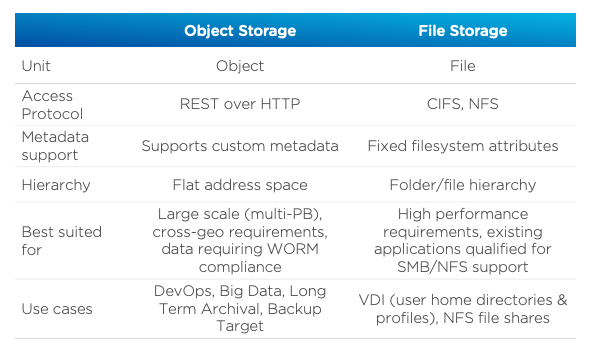
An object store is a repository for storing objects. Objects are stored in a flat hierarchy and made up of only 3 attributes - an unique key or identifier, the data itself, and an expandable amount of metadata. An object store is a single global namespace on which buckets can be created. A bucket can be thought of as similar to a folder in a file storage environment. However, object storage and file storage are very different. Here are some ways object storage and file storage differ.
Getting Familiar with the Nutanix Objects Environment
This exercise will familiarize you with the Nutanix Objects environment. You will learn:
What constitutes the Microservices Platform (MSP) and the services that make up Nutanix Objects.
How to deploy an Object Store
View the Object Storage Services
Login into your Prism Central instance.
In Prism Central, select > Services > Objects.
View the existing Object Stores. You will be using the ntnx-objects Object Store throughout this lab.
Select > Virtual Infrastructure > VMs.
For the lab deployment, you will see 2 VMs, each preceded with the name of the object store.
Note
In a production environment, there would be at a least 5 VMs - 3 worker VMs (default) and 2 load balancers (envoy). In Medium and Large deployments there would be additional worker and load balancer VMs.
For example, if the name of the object store is ntnx-objects, there will be a VM with the name ntnx-objects-envoy-1.
VM
Purpose
vCPUs | Memory
default-0
Kubernetes Node
10 | 32 GiB
envoy-0
Load Balancer / Endpoint
2 | 4 GiB
These VMs are deployed by the Microservices Platform (MSP), the Kubernetes-based platform on which multiple future Nutanix services will be run. The service that controls the MSP runs on Prism Central.
The default VMs run the Kubernetes cluster. The Kubernetes cluster consists of one or more master nodes, which provides the control plane for the Kubernetes cluster, as well as worker nodes. Kubernetes runs in multi-master mode, which allows for any node to become the master if needed.
These nodes run etcd, which is a Kubernetes-level distributed key-value store for storing and replicating the Kubernetes-cluster level metadata. The nodes also run the object store components. This includes:
S3 adapter - Translates the S3 language into the internal system language
Object controller - Handles all the I/O
Metadata service - Distributed key-value store to provide consistency across a massive object store deployment
Atlas service - Handles garbage collection and enforces policies such as life cycle management, versioning, and WORM
UI gateway - this is the endpoint for all UI requests, handles bucket management, stats display, user management interface, etc
Zookeeper - Manages the configuration for the object storage cluster
IAM service - Handles user authentication for accessing buckets and objects
The envoy VMs provide load balancing across the object controller components. The IP address of these VMs are the IP that can be used by clients to access the object store. It is the first point of entry for an object request (for example, an S3 GET or PUT). It then forwards this request to one of the worker VMs (specifically, the S3 adapter service running as part of the object-controller pod).
Walk Through the Object Store Deployment
In this exercise you will walk through the steps of creating an Object Store.
You will not actually deploy the Object Store, but you will be able to see the workflow and how simple it is for users to deploy an Object Store.Note
In many use cases only a single object store is required. If global namespace isolation is required, for example if a Service Provider is providing object storage to multiple customers from the same cluster, then multiple object stores can be created.
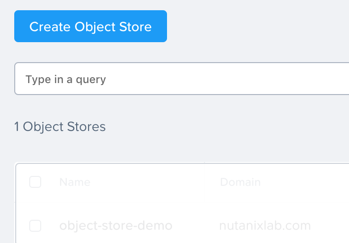
In > Services > Objects, click Create Object Store.
Review the prerequisites and click Continue.
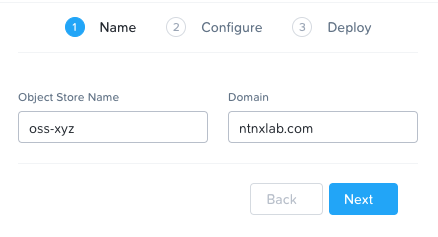
Fill out the following fields:
Object Store Name - initials-oss
Domain - ntnxlab.com
Click Next.
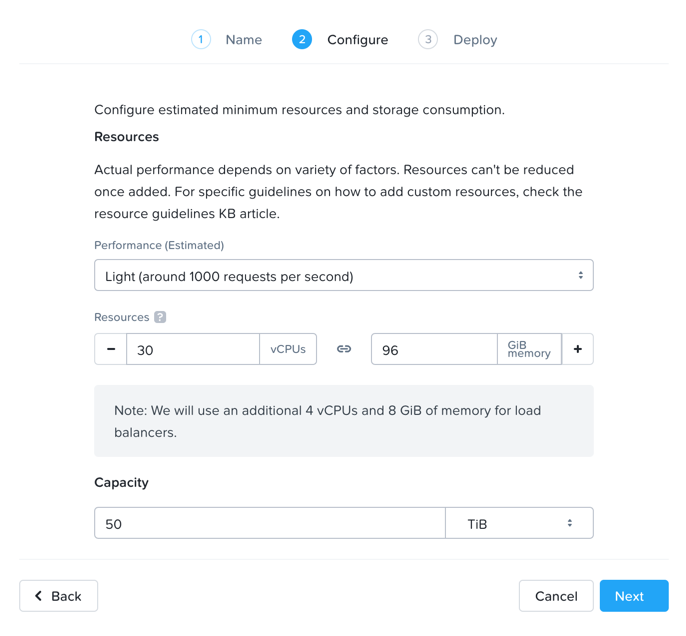
Next you will be able to configure the capacity of your object store.
The chosen option determines how many nodes will be deployed and the size of each.
Note
Note that although a storage capacity is defined here, it is not a hard limit. Storage capacity is limited only by the license and the available storage capacity of the cluster.
Select the different options (Small, Medium, Large) and notice how the Resource numbers change. These are the resources that will be applied across the K8s worker VMs. For example, specifying 30vCPU and 72GB of RAM across 3 workers, comes to 10 vCPU and 24 GB of RAM per worker. Custom values are also allowed.
Select Light, 50TiB for Capacity, and click Next.
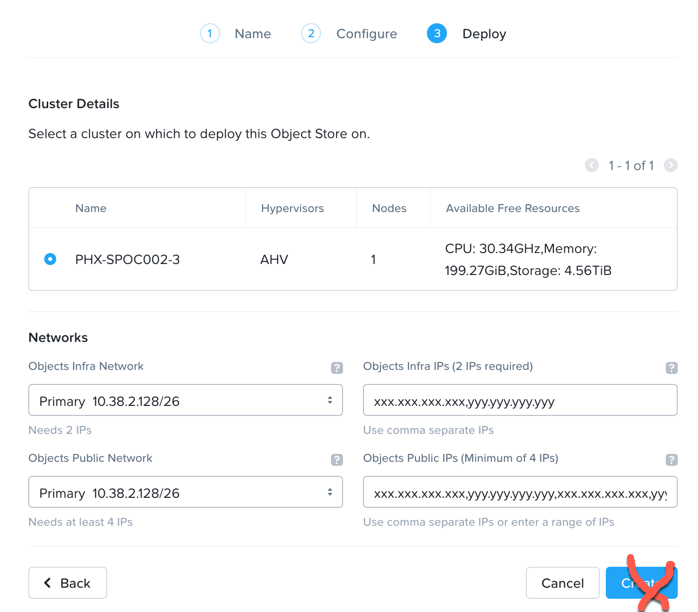
On the final screen, you will see the clusters managed by Prism Central.
Note
To help validate that the Object Store is being deployed in the proper cluster, administrators can easily see the CPU, Memory, and Storage runways for each of the clusters.
Select the assigned cluster and note the expanded Network dialog.
Internal Access Network: This is the network where the MSP VMs will communicate, which requires 18 IP addresses to be reserved (for scale out). Select the Primary Network.
Internal Access IPs: These are additional IPs for internal communication and are required to be static. Two static IPs are required.
Client Access Network: This is the network for client access. This network can be the same as the Infrastructure Network.
Client Access IPs: These are the endpoint IPs that the external applications will connect to. 4 static IPs are required.
On the main Objects UI, take a note of the IP address in the Client Used IPs column for the existing object store, as it will be used in a future lab.
Takeaways
What are the key things you should know about Nutanix Objects?
Nutanix Objects provides a simple and scalable S3-compatible object storage solution, optimized for DevOps, Long Term Retention and Backup Target use cases.
Nutanix Objects can be deployed on an AHV cluster, with ESXi support on the roadmap.
Nutanix Objects will be enabled and deployed from Prism Central.